For 35-year-old Hathani Tharuni, a single mother living in the landless settlement of Khaireni VDC in the Chitwan district, survival was a daily battle. After tragically losing her husband in an accident, the illiterate widow found herself solely responsible for feeding her two young daughters. Grappling with severe poverty, the meager wages she earned from hard physical labor were her only means to keep her family from going hungry.
Her life began to change when she connected with the “Efficient Land Management for Socio-Economic Enhancement in Southern Nepal” program, implemented by MRC Nepal with financial assistance from OPEC/OFID. The program integrated Hathani into a localized vegetable production group, encouraging her to start growing her own crops. Initially, she was deeply reluctant—how could someone who was nearly landless become a farmer? However, she was eventually persuaded to take a leap of faith by leasing a patch of “marginal wasteland” along the riverbed, land that was considered nearly valueless by others.
Hathani leased just 3,360 square meters of this riverbed. Armed with technical guidance and agricultural inputs from MRC Nepal, she meticulously planted and cultivated green peas (Pisum sativum).
A Record Harvest
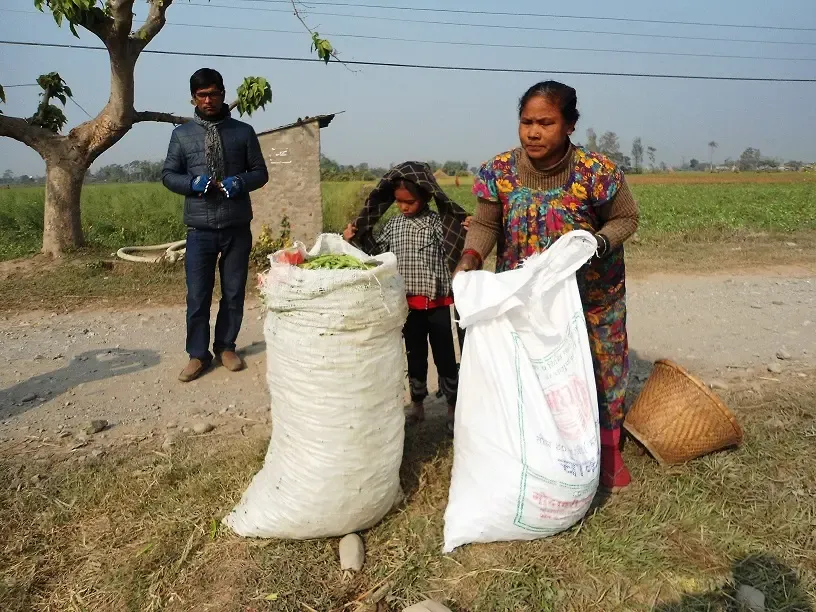
The outcome was astonishing. Within just four months, Hathani harvested 2,450 kilograms of green pods. This yielded an unprecedented income of NRs. 80,000 (equivalent to approximately $2,700 per hectare). She had never seen such a massive return in her life. Energized and inspired by her successful first season, Hathani immediately began planning to lease more land to scale up her newfound enterprise.
The income from her vegetable harvest was entirely life-changing. She was finally able to cover basic household expenses with ease, repay outstanding loan installments, fund her children’s education, and comfortably afford healthcare.
“The support provided by MRC Nepal and OFID has been an absolute boon for me,” Hathani expressed with a radiant smile. “This kind of support shouldn’t just stop—it should continue until we become completely self-reliant. Only then will our lives truly transform into a dignified existence for our families.”