For 34-year-old Pramila Devi Paswan from Haraiya-6, Bara, the daily struggle to sustain a family of ten was an exhausting reality. With her husband’s modest income as a driver serving as the family’s only financial pillar, putting enough food on the table was a constant challenge. Following traditional practices, the family cultivated rice and maize during their respective seasons, but left their precious land completely fallow for the remainder of the year. To make ends meet, Pramila was often forced to work as a daily wage laborer on neighboring landlords’ fields.
The turning point arrived when Pramila joined the “Efficient Land Management for Socio-Economic Enhancement in Southern Nepal” project. Financed by OFID and technically guided by MRC Nepal, the initiative provided her with essential technical training and high-quality agricultural inputs in October 2012.
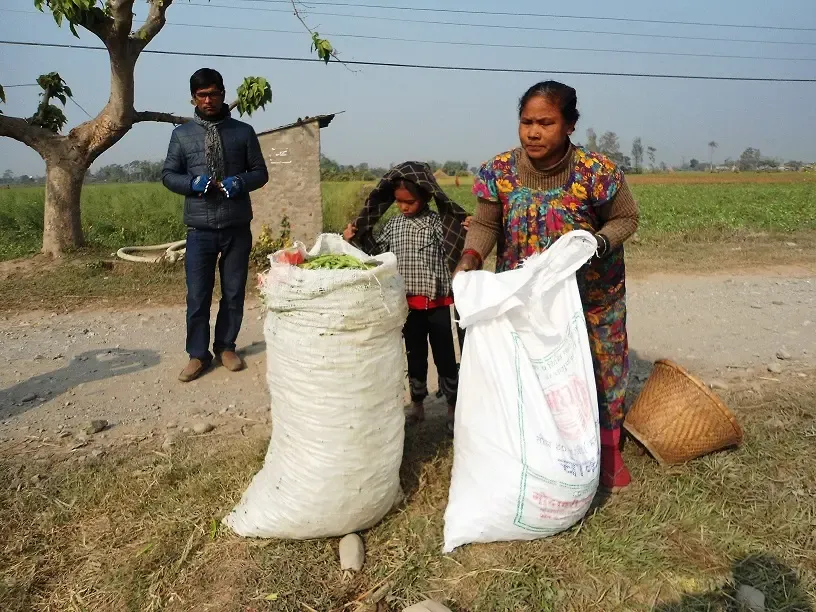
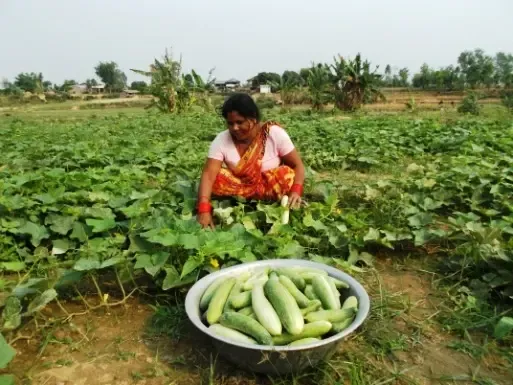
Empowered by her newfound knowledge, Pramila boldly transitioned from subsistence farming to commercial vegetable production. In early February 2013, she transformed 672 square meters of marginal riverbed land near the Pasaha River into a vibrant, high-yield vegetable farm—planting cucumber, bitter gourd, bottle gourd, okra, and cowpea.
A Harvest of Hope
The results were nothing short of extraordinary. Within just two and a half months, Pramila earned over NRs 29,000 (equivalent to an impressive $5,394 per hectare)—and the harvest was still ongoing. The transformation from a struggling daily wage worker to an independent, prosperous farm owner brought immense joy and confidence to her life. Fueled by this success, she is already planning to cultivate early-winter cauliflower on an even larger scale.
“The practical-based training and quality inputs provided by MRC Nepal with the support of OFID have been incredibly encouraging for resource-poor producers like me. I hope this support continues until we are entirely self-reliant.”
Reflecting on her journey, Pramila beams with pride: “This project truly granted me a new life by uplifting our livelihoods. It has become significantly easier to support my large family, and because of this increased income, my children will finally get the chance to pursue their studies. I am deeply thankful to OFID and MRC Nepal for giving me the tools to harness my marginal riverbed land to transform my family’s future.”